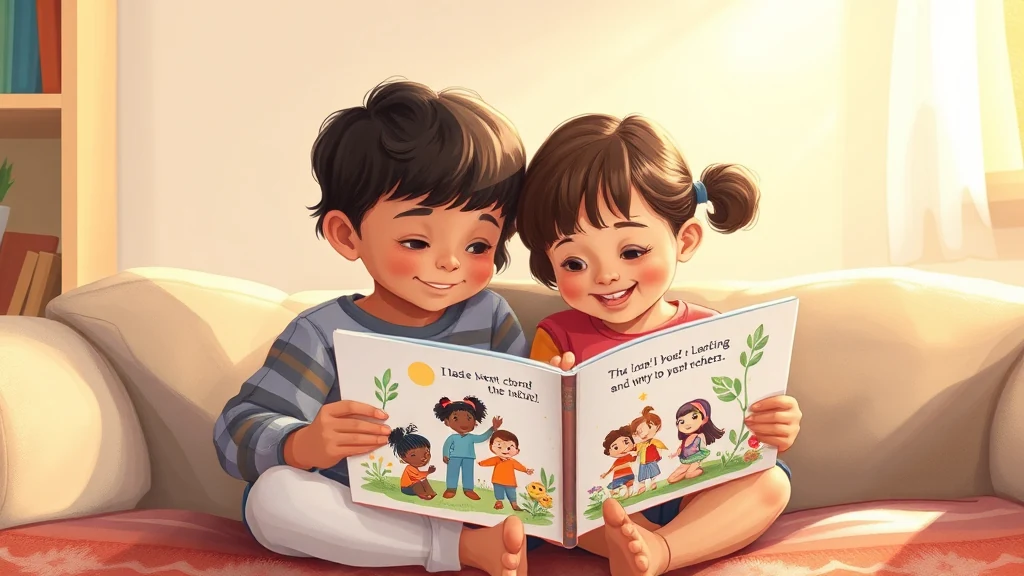
Do you ever find yourself watching your children interact-a moment of shared laughter one minute, and a sudden, sharp disagreement the next? Sibling relationships are perhaps the most profound, complex, and rollercoaster-like dynamics a child experiences. They are our first practice ground for negotiating boundaries, sharing attention, and managing intense emotions like jealousy, cooperation, and deep loyalty.
While these interactions are vital for building resilience, the arguments and moments of feeling ‘overshadowed’ are real struggles for parents to navigate. Sometimes, the emotions feel too big, too messy, or too difficult to discuss with simple “use your words” advice. How can we help children process these complex, invisible dynamics of love and conflict? The answer, often surprisingly, lies in the narrative itself.
Why Sibling Dynamics Are So Important for Development
Psychologists view the sibling relationship as a cornerstone of social and emotional development. It’s where children learn concepts that go far beyond just ‘playing together.’ They learn:
- Negotiation: Sharing toys, turns, and parental attention.
- Empathy: Understanding another person’s viewpoint, even when that person is the sibling.
- Identity: Discovering who they are in relation to others.
When conflict arises, it’s rarely about the sticker or the toy; it’s about something deeper-a perceived imbalance of affection, a need for recognition, or a feeling of not being understood. Because the source of the tension is often emotional and abstract, traditional advice can sometimes feel hollow against the weight of a real-life feeling.
The Therapeutic Power of Externalizing Conflict Through Stories
This is where the magic of storytelling steps in. Stories provide a safe, non-judgmental sandbox where feelings can be externalized.
What does externalizing mean? It means taking an internal, messy feeling (like “I feel like Leo never listens to me”) and placing it outside of the person, giving it a narrative shape. In a book, the disagreement becomes a plot point, and the resolution becomes a character arc.
When children see their dynamic-the teasing, the cooperation, the rivalry-mirrored in a story, they gain crucial distance. They can observe the conflict as “the story’s problem” rather than “our permanent reality.” This allows for processing through narrative catharsis.
Moving Beyond Generic Scenarios
Generic stories about siblings can be helpful, but they often fail because they don’t reflect the specific nuances of your family. The way your children argue, the inside jokes, the specific things they bond over-these are unique.
This is why personalized narrative experiences are so potent. When a child sees their own traits, their sibling’s strengths, and their family history woven into the fabric of a story, it transforms from mere entertainment into a powerful act of self-recognition and validation. For instance, if one child struggles with taking turns, seeing a personalized character who shares your child’s traits masterfully learning the value of waiting can feel incredibly real and actionable. The process of creating these narrative touchstones can be deeply rewarding; if you are looking for a tangible way to start this journey of understanding, visualizing your unique family moments through a personalized book can be a wonderful first step by creating a draft at https://makemybook.app/en/console.
How to Best Use Personalized Books with Siblings
If you choose to create a personalized book focused on sibling dynamics, how do you maximize its impact?
1. Identify the Core Emotion, Not Just the Action: Before starting, ask yourselves: Is the conflict about who gets the tablet, or is it about who gets the most parental attention right now? Once you identify the root emotion (e.g., jealousy, feeling unheard), ensure the story’s central challenge revolves around resolving that emotion.
2. Focus on Roles and Strengths: The story shouldn’t just show them fighting; it should show them complementing each other. Perhaps one child excels at planning (the Strategist), while the other is brilliant at executing the ideas (the Doer). A personalized book can explicitly map out these unique, interdependent strengths.
3. The “Bridging” Narrative: A powerful structure is to use the story to “bridge” two separate personalities or interests together. Maybe Character A loves dinosaurs, and Character B loves baking. The plot requires them to combine their skills-the dinosaur knowledge is needed to dig up a rare ingredient for the cake. This models teamwork over competition.
The Parent’s Role: Reading Aloud as a Joint Activity
The book is a tool, but the reading ritual is the therapy session. When you read these books aloud, shift your energy from solving the problem to sharing the experience.
- Pause for Prediction: Stop right before a moment of conflict. “What do you think will happen next? Will Maya argue, or will Liam step in to help?” This engages their critical thinking skills.
- Validate Feelings: When a character feels frustrated, pause and say, “It must feel really frustrating to be misunderstood, doesn’t it?” You are validating the feeling attached to the character, which helps them associate the emotion with the story rather than with their sibling in real life.
- Celebrate Connection: When the characters resolve the conflict through understanding, celebrate that resolution loudly and genuinely.
The true beauty of a personalized story is that it belongs to them. It validates their lived experience-the ups, the downs, the compromises-and wraps it in the safety of art. It gives them a shared language for an emotional landscape that can otherwise feel too vast and overwhelming to map out.
Creating a personalized book isn’t about eliminating disagreement; it’s about equipping your family with a shared language and a comforting narrative framework to understand what is happening when the fun gets a little complicated.