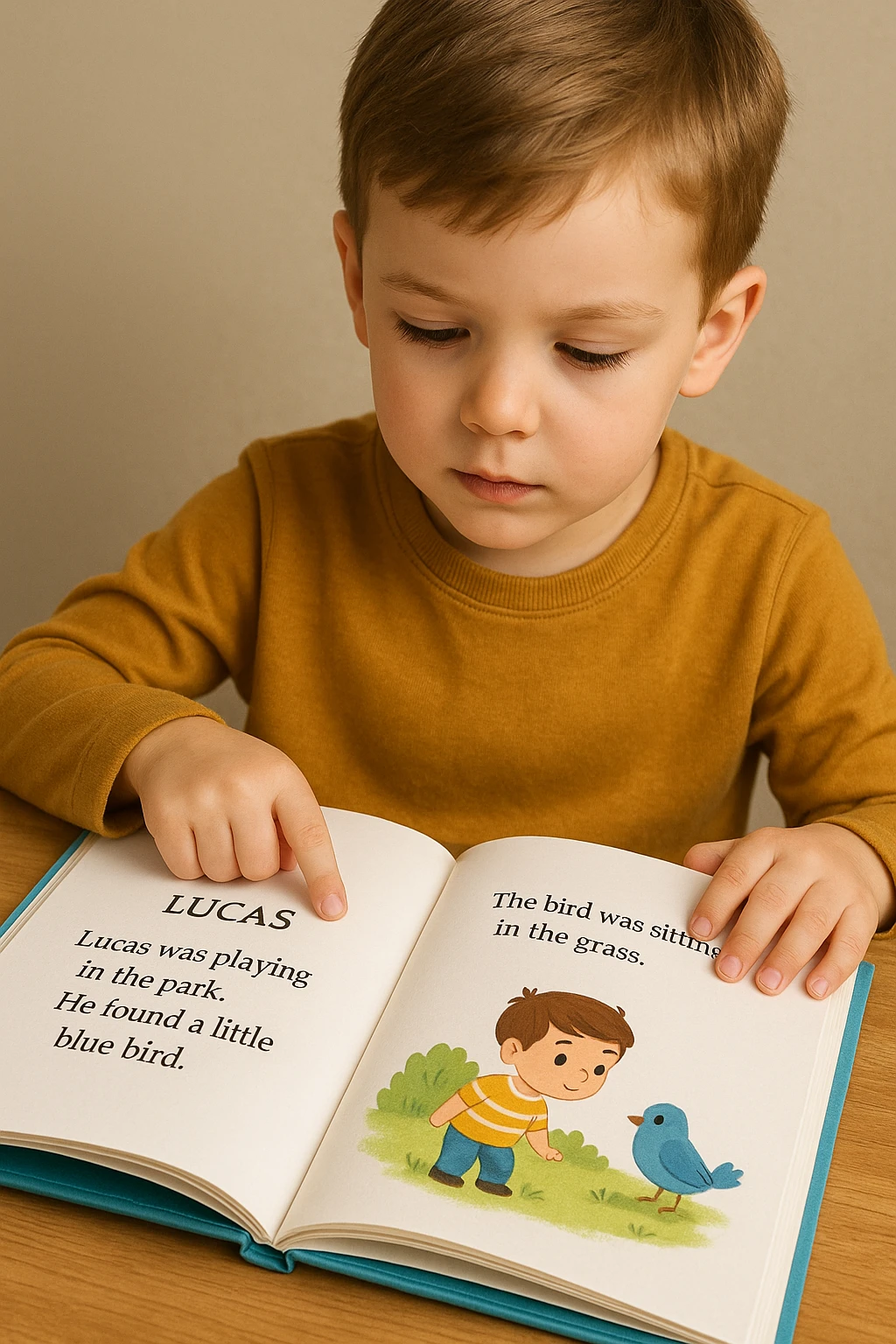
How Personalized Books Contribute to Cognitive and Linguistic Development
The relationship between reading and child development has been extensively studied, but personalized books add a unique dimension to this research. When children see themselves as the protagonist of a story, something remarkable happens in their developing brains - learning becomes more engaging, memorable, and effective.
The Science Behind Personalized Learning
Neuroscience research reveals that personalized content activates different neural pathways than generic stories. When information relates directly to the self, the brain’s default mode network - responsible for self-referential thinking - becomes more active. This heightened engagement translates to improved memory retention and deeper comprehension.
The Self-Reference Effect
The self-reference effect is a well-documented psychological phenomenon where information related to oneself is remembered better than information about others. This effect begins in early childhood and becomes particularly powerful when children see their name, appearance, or personal details in educational materials.
Studies with preschoolers demonstrate that children as young as three years old show enhanced memory for words and concepts when they’re presented in a self-referential context. Personalized books leverage this natural cognitive advantage, making learning more effective without children even realizing they’re studying.
Early Literacy Skills Development
Name Recognition and Phonological Awareness
One of the first steps in literacy development is recognizing that print has meaning. Personalized books accelerate this process dramatically. When children repeatedly see their name in print, they begin to understand:
- Letter-sound relationships: Children notice that specific letters create specific sounds
- Word boundaries: They learn where words begin and end
- Print conventions: They understand that text flows in a particular direction
- Symbol recognition: They connect visual symbols (letters) with meaning
The repeated exposure to their name in various contexts helps children develop phonological awareness - the ability to hear and manipulate sounds in words. This foundational skill is crucial for later reading success.
Orthographic Processing
Personalized books also support orthographic processing, which involves recognizing letter patterns and word structures. When children see their name frequently:
- They memorize the visual pattern of letters
- They recognize these letters in other contexts
- They begin to identify similar patterns in other words
- They develop automatic word recognition
This early orthographic knowledge provides a strong foundation for reading fluency and comprehension.
Vocabulary Expansion Through Personal Relevance
Contextual Learning
Traditional vocabulary instruction often presents words in isolation or generic contexts. Personalized books embed new vocabulary within stories that children find personally meaningful. This contextual approach offers several advantages:
- Emotional connection: Children remember words better when they’re associated with personal experiences
- Multiple exposures: The same words appear naturally throughout the story
- Rich context: Words are presented with visual and narrative support
- Active engagement: Children are motivated to understand words because they want to follow “their” story
Vocabulary Acquisition Patterns
Research shows that children learn vocabulary more rapidly when:
- Words appear in contexts relevant to their lives
- They encounter words multiple times in meaningful ways
- Words are connected to their existing knowledge
- Learning feels like play rather than instruction
Personalized books naturally incorporate all these elements, creating optimal conditions for vocabulary growth.
Reading Comprehension Enhancement
Deeper Engagement
When children read personalized stories, they’re not just processing text - they’re actively participating in a narrative about themselves. This personal investment leads to:
- Improved attention: Children focus more intently on stories featuring themselves
- Better prediction skills: They anticipate what might happen to “them” in the story
- Enhanced inference: They draw connections between story events and their own experiences
- Stronger retention: They remember story details more accurately
Metacognitive Development
Personalized books also support metacognitive skills - thinking about thinking. As children engage with stories about themselves, they begin to:
- Monitor their own understanding
- Recognize when they’re confused
- Ask questions about the story
- Make connections to their own lives
These metacognitive abilities are essential for independent reading and learning.
Memory and Information Processing
Episodic Memory Formation
Personalized stories create episodic memories - memories of specific events and experiences. These memories are particularly strong because they combine:
- Personal relevance: The story is about the child
- Emotional engagement: Children feel excited and invested
- Visual imagery: Illustrations reinforce the narrative
- Repetition: Children often request these stories multiple times
The strength of these memories supports long-term learning and knowledge retention.
Working Memory Benefits
Working memory - the ability to hold and manipulate information temporarily - improves through engagement with personalized books. Children must:
- Remember character names and relationships
- Track story events and sequences
- Connect new information to existing knowledge
- Maintain focus throughout the story
These cognitive demands strengthen working memory capacity, which supports academic achievement across subjects.
Language Structure and Grammar
Natural Grammar Acquisition
Personalized books expose children to proper grammar structures in natural contexts. Unlike grammar drills, children absorb:
- Sentence patterns: They hear correct sentence structures repeatedly
- Verb tenses: They encounter various tenses in meaningful contexts
- Complex sentences: They experience sophisticated language naturally
- Conversational patterns: They learn how language flows in dialogue
This natural exposure supports implicit grammar learning, which is more effective than explicit instruction for young children.
Syntax Development
As children engage with personalized stories, they develop understanding of:
- Word order: How words are arranged to create meaning
- Sentence structure: How sentences are built
- Paragraph organization: How ideas connect across sentences
- Story structure: How narratives are organized
This syntactic knowledge supports both reading comprehension and writing skills.
Cognitive Flexibility and Problem-Solving
Narrative Thinking
Personalized books encourage narrative thinking - the ability to understand and create stories. This cognitive skill involves:
- Sequencing: Understanding cause and effect
- Perspective-taking: Seeing situations from different viewpoints
- Problem-solving: Finding solutions to story challenges
- Creative thinking: Imagining alternative outcomes
These skills transfer to real-world problem-solving and academic tasks.
Executive Function Development
Executive functions - mental processes that help manage thoughts and actions - develop through engagement with personalized books. Children practice:
- Inhibition: Focusing on the story despite distractions
- Working memory: Remembering story details
- Cognitive flexibility: Adapting to story twists and turns
- Planning: Anticipating story progression
Strong executive functions predict academic success and life outcomes.
Age-Appropriate Cognitive Benefits
Toddlers (2-3 years)
For the youngest readers, personalized books support:
- Object permanence: Understanding that things exist even when not seen
- Symbolic thinking: Recognizing that pictures represent real things
- Cause and effect: Understanding simple story sequences
- Language comprehension: Building receptive vocabulary
Preschoolers (4-5 years)
Older preschoolers benefit from:
- Pre-reading skills: Letter recognition and print awareness
- Narrative understanding: Following story sequences
- Emotional vocabulary: Learning words for feelings
- Social cognition: Understanding relationships and interactions
Early Elementary (6-8 years)
School-age children develop:
- Reading fluency: Smooth, accurate reading
- Comprehension strategies: Understanding and analyzing text
- Critical thinking: Evaluating story elements
- Writing skills: Using stories as models for their own writing
Supporting Children with Learning Differences
Specialized Benefits
Personalized books offer particular advantages for children with learning differences:
- Dyslexia: The personal connection increases motivation to decode text
- ADHD: High engagement helps maintain attention
- Language delays: Repeated exposure supports language development
- Autism spectrum: Personal relevance helps with comprehension and engagement
Individualized Learning
The customization inherent in personalized books allows for:
- Appropriate challenge levels: Content matches individual abilities
- Interest-based learning: Stories align with personal preferences
- Cultural relevance: Content reflects family background
- Flexible pacing: Children can revisit stories as needed
Practical Applications for Parents and Educators
Maximizing Benefits
To maximize cognitive and linguistic benefits:
- Read together: Shared reading enhances learning
- Ask questions: Encourage thinking about the story
- Make connections: Link story events to real life
- Extend learning: Use stories as springboards for activities
- Repeat readings: Multiple exposures strengthen learning
Creating Learning Opportunities
Transform reading time into learning time by:
- Identifying letters: Point out letters in the child’s name
- Counting words: Count words on pages together
- Predicting outcomes: Ask what might happen next
- Discussing emotions: Talk about how characters feel
- Exploring vocabulary: Explain new words in context
Long-Term Academic Impact
Reading Achievement
Children who engage with personalized books show:
- Earlier reading readiness: They’re prepared for formal reading instruction sooner
- Better reading comprehension: They understand texts more deeply
- Increased reading motivation: They choose to read more often
- Stronger vocabulary: They know more words and use them correctly
Overall Academic Success
The cognitive skills developed through personalized books support:
- Mathematics: Problem-solving and pattern recognition
- Science: Observation and analysis skills
- Social studies: Understanding narratives and perspectives
- Writing: Story structure and language use
Conclusion
Personalized children’s books are far more than entertainment - they’re powerful tools for cognitive and linguistic development. By leveraging the self-reference effect and creating deeply engaging learning experiences, these books support:
- Early literacy skills
- Vocabulary development
- Reading comprehension
- Memory formation
- Language structure understanding
- Cognitive flexibility
- Executive function development
The personal connection that makes these books so enjoyable also makes them remarkably effective for learning. When children see themselves as the hero of a story, they’re not just reading - they’re actively engaging their brains in ways that support long-term academic and cognitive development.
For parents and educators seeking to support children’s development, personalized books offer a unique combination of engagement and education. They transform learning from a task into an adventure, making cognitive and linguistic growth feel natural and enjoyable.
The magic of personalized books lies in their ability to make learning personal. When children see their name on a page, they’re not just recognizing letters - they’re building the cognitive and linguistic foundations that will support their learning for years to come. This personal connection transforms reading from a skill to be mastered into a journey of discovery where the child is both the reader and the hero.